
What are Adder Stones (Hühnergötter)?
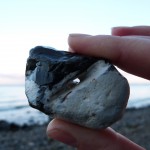
Adder stones – known in Germany as Hühnergötter (literally “chicken gods”), and elsewhere as hag stones, witch stones, or holey stones – are naturally perforated rocks with a hole passing completely through from one side to the other. Most commonly found along the Baltic and North Sea coastlines, these stones are typically made of dark grey to deep black flint enveloped by a chalky white crust.
How Does an Adder Stone Form?
Geologically, an adder stone is a nodule of flint formed during the Cretaceous period millions of years ago. Fossilised sea creatures (such as sponges, sea urchin spines, or belemnites) or softer chalk pockets became trapped inside the silica matrix. Over millennia of rolling in tidal surf and reacting with seawater, the softer organic and chalk inclusions slowly dissolve or get knocked loose – leaving behind a perfectly natural cylindrical hole.
Why are Adder Stones Considered Lucky Charms?
For centuries, beachgoers and coastal communities have revered holey stones as talismans of good fortune, protection, and health. In folklore, hanging an adder stone in the coop was believed to safeguard poultry from predators and disease (hence the German name Hühnergott), while sailors tied them to their boats to ward off storms. Today, many beachcombers thread their finest finds onto leather cords to wear around their neck or display them as decorative lucky stones at home. Children especially love searching for them – they are genuine nature treasures that anyone can discover with patience and keen eyes.
What Other Treasures Can You Find on the Shoreline?
Adder stones are just one of the wonderful treasures awaiting discovery on our beaches:
- Amber (Bernstein): The “gold of the sea” – fossilised tree resin that floats lightly in saltwater and glows golden in sunlight or under UV rays.
- Belemnites (Donnerkeile / Thunderbolts): The fossilised internal shells of prehistoric cephalopods, resembling smooth stone bullet points or amber darts.
- Sea Glass: Smooth, frosted pieces of tumbled glass polished by waves over decades.
- Fossilised Sea Urchins: Beautiful petrified echinoids preserved in flint nodules.
I have personally found all of these treasures along the German Baltic and North Sea beaches – especially during early morning walks following stormy nights when the surging surf stirs up deep seabed deposits. Beachcombing is one of the most calming, rewarding outdoor activities imaginable!
🔍 Recommended Gear for Beachcombers & Rock Hounds
- Amber Hunting UV Torch: A 395nm UV flashlight makes real amber glow neon yellow in wet seaweed and sand.
- Fossil Identification Field Guide: A handy pocket guide like Beachcombing & Fossil Guides helps quickly identify rocks, shells, and fossils.
- Canvas Collecting Bag: A breathable cotton canvas bag prevents wet shells and stones from sweating.